

What the FIFA World Cup and 2028 Olympics Will Actually Do to LA Real Estate
Two massive global events are about to reshape the Los Angeles spotlight. The FIFA World Cup arrives this June, with eight matches at SoFi Stadium — temporarily renamed "Los Angeles Stadium" — kicking off June 12 with the U.S. Men's National Team vs. Paraguay. Two years after that, in summer 2028, the Olympics return to LA for the first time since 1984, with the opening ceremony also at SoFi.
Every real estate conversation in the city seems to involve some version of the
same question: what will this actually do to property values? Will prices
spike? Should I list now? Should I wait? Should I buy in Inglewood?
The honest answer is more nuanced than the social media takes suggest. There's
a real opportunity here for certain neighborhoods and certain types of property
— and there's also a lot of hype that won't translate into lasting value.
Here's what the data actually says.
The short-term picture: a multi-week tourism surge, not a real estate boom
Let's start with what's measurable.
The Los Angeles Sports & Entertainment Commission projects nearly $892
million in regional economic impact from the World Cup alone, with $515+
million coming from direct visitor spending on lodging, dining, retail, and
transportation. Combined with media value from increased future tourism, the
total impact is projected to surpass $1.1 billion.
The expected visitor profile matters. The U.S. is expected to welcome up to
1.24 million international visitors for the tournament across all host cities.
LA specifically anticipates roughly 150,000 out-of-town visitors, with average
spending per visitor projected at $2,350 — about half of which goes to lodging.
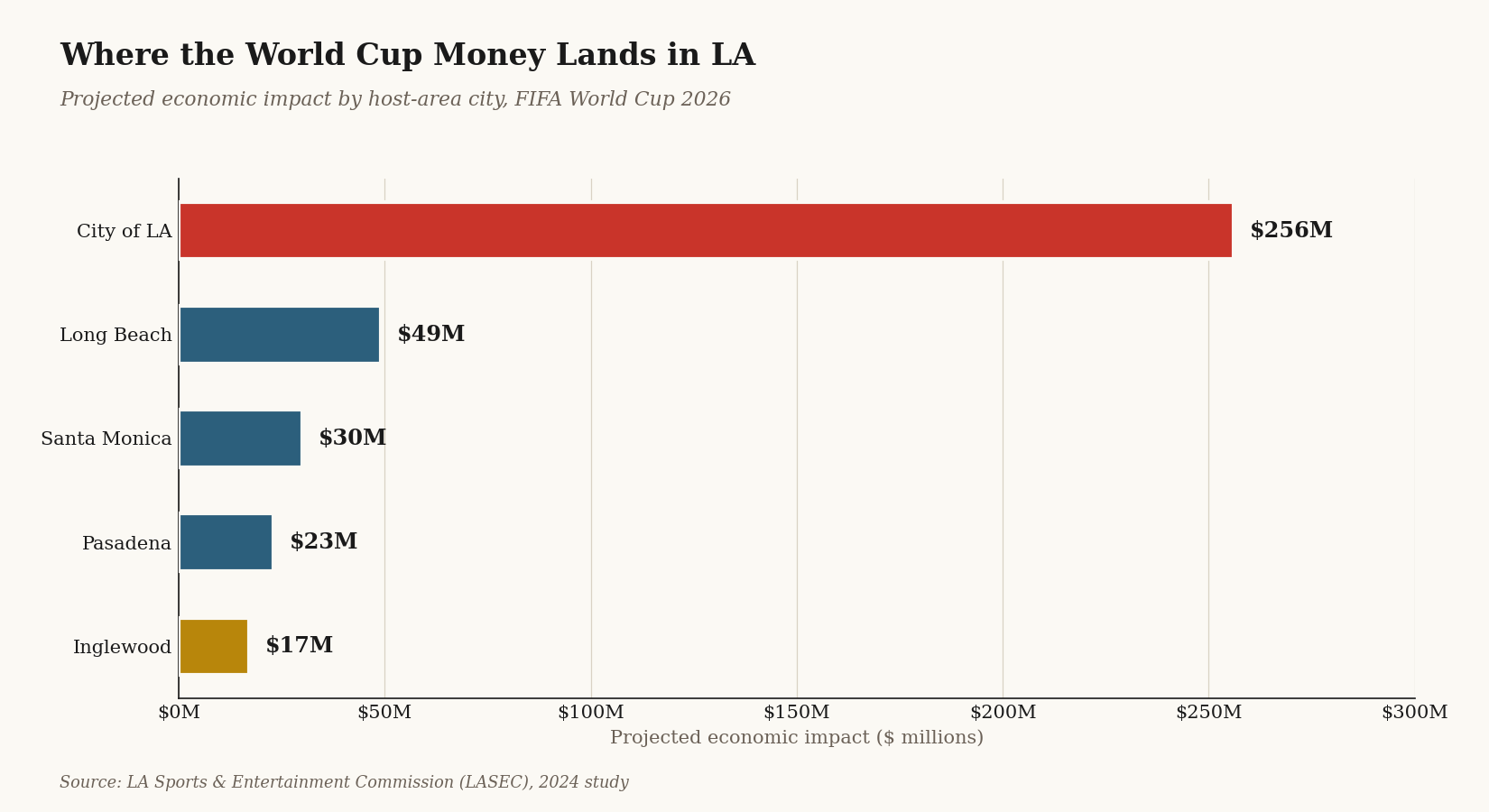
Distributed across the region, the city of Los Angeles itself is forecast to
see $256 million in total economic impact. Inglewood (home to SoFi) gets $17
million directly. Long Beach is projected at $49 million, Santa Monica at $30
million, Pasadena at $23 million.
That's a tourism event, not a housing event. The economic activity flows
through hotels, restaurants, transportation, and short-term rentals — not home
sales.
Where short-term rentals genuinely benefit
This is where the real near-term opportunity sits. STRs near SoFi Stadium,
along the Metro K Line corridor, and in walkable hotel-adjacent neighborhoods
are going to see the biggest demand spike of any LA event in recent memory.
The pattern is going to look different from a Super Bowl or a single
Wrestlemania weekend. The World Cup runs from June 11 through mid-July — 39
days of fan engagement in LA — and the eight matches at SoFi include the USMNT
opener, four additional group stage matches, two Round of 32 knockout games,
and one quarterfinal. That schedule produces sustained demand rather than a
single weekend spike.
A few things to know if you're considering listing on Airbnb or VRBO for the
tournament:
- Volatile demand by date.** Group-stage matches involving high-draw teams (USA, Mexico, big European nations) drive rates much higher than matches between lower-profile teams. If a popular team advances into the knockout rounds at SoFi, the four-day window around that match can see rates climb dramatically. The week of the USMNT opener will be the strongest revenue window in the entire tournament.
- Location language matters more than amenities.** Specific mentions of transit access ("15 minutes to the stadium via the K Line") tend to outperform generic luxury features. International soccer fans are used to public transit and many won't be renting cars.
- Hotel pricing sets a ceiling, not a floor.** Luxury hotels in LA will benchmark high during the tournament, and STRs that exceed those prices without offering meaningfully more space or amenities tend to sit unbooked. Pricing at the 90th percentile with a modest buffer is more effective than aspirational pricing
For the Olympics in 2028, the dynamics will be similar but bigger and longer. The Games run roughly 17 days (July 14–30, 2028 for the Olympics; the Paralympics follow). Venues are spread across LA in a way the World Cup isn't, which broadens which neighborhoods benefit.
The long-term real estate question: what actually changes?
Now for the harder question, the one most homeowners are really asking. Does hosting these events permanently lift property values?
History is mixed at best. Studies of past Olympic host cities show that the
lasting property-value effects depend almost entirely on whether the Games
triggered durable infrastructure investments that improved the underlying
neighborhood — not on the Games themselves. Atlanta '96, Salt Lake '02,
Vancouver '10, and London '12 all show the same pattern: where new transit
lines, new commercial corridors, and serious public investment landed, values
rose meaningfully. Where it was just the temporary spectacle, the effect faded
within a couple of years.
LA's situation is different from past Olympic hosts in one important way: this
is the first Games to be built almost entirely on existing venues. SoFi, the
Coliseum, Crypto.com Arena, Long Beach venues, Pauley Pavilion at UCLA — most
of the infrastructure already exists. That means less new construction, less
new transit, and less of the kind of footprint that durably reshapes
neighborhood values.
The exceptions are worth watching closely.
Where the durable real estate impact might actually land
Inglewood and the SoFi corridor. This is the one neighborhood with both
events anchored to it. SoFi will host eight World Cup matches in 2026, the 2028
Olympic opening ceremony, and be converted into the largest Olympic swimming
venue in history. The Intuit Dome opened nearby. The Metro K Line runs to it.
Property values in Inglewood have already risen significantly since SoFi
opened, and the next two years of global attention will keep that trajectory
going.
But the lesson of past events is that the buying window often closes well
before the event itself. Buyers who got into Inglewood in 2019–2021 captured
most of the run-up. Buying in 2026 for the 2028 Olympics is more about whether
you want to live there long-term than whether the Games will trigger another
major price step.
The Exposition Park corridor. USC, the Coliseum (Olympic opening ceremony
venue for 1932 and 1984, and a 2028 venue), the future Lucas Museum, and
connecting Metro lines make this a candidate for durable upgrading. The
neighborhood has been changing for years; the Olympics may accelerate it.
Downtown LA. Significant World Cup foot traffic is expected to funnel
through DTLA, and the city is treating it as a "test run for the
Olympics." Whether that translates into durable real estate impact depends
largely on what happens to DTLA's office-to-residential conversion trajectory
over the next two to three years — a much bigger force in its own right.
Long Beach. Olympic sailing, BMX, water polo, and other events will be
hosted there. Long Beach has been seeing organic growth from its own factors
(the port, downtown revitalization, the proximity to Orange County jobs). The
Games will reinforce that, but probably won't create new dynamics.
Transit-adjacent neighborhoods generally. The single most reliable
historical predictor of lasting real estate gains from major events has been
new or improved transit. LA's Metro expansion (the Purple Line extension, the
East San Fernando Valley Light Rail, the Sepulveda Transit Corridor in earlier
planning stages) is happening regardless of the Olympics. But the Games are
accelerating completion timelines on some of it, and properties near new
stations stand to benefit from that acceleration.
What this means for sellers right now
If you're thinking about timing a sale to the events, here's the honest read.
Listing in spring 2026, before the World Cup, doesn't have a strong "event premium" attached for typical residential sales. Tourists don't buy houses — they rent them. The buyers active in the LA market in 2026 are mostly the same buyers who would be active without the World Cup: local move-up buyers, relocations, investors. They're not paying a premium because international fans will be in town for a month.
The exception is if you own a property specifically suited to investor buyers — a turnkey unit near SoFi or the Coliseum with strong STR income history, or a multifamily property where short-term rental cash flow makes the math work. Investor buyers underwriting based on event-window revenue may pay a modest premium, but they're also doing detailed math and won't overpay much beyond what the actual income supports.
If you own an STR-eligible property near event venues and aren't planning to sell, the better short-term strategy is to capture the rental income directly during the tournament and Games rather than trying to sell into a "World Cup premium."
What this means for buyers
A few practical takeaways.
- Don't buy into "Olympic effect" hype as the primary reason to purchase. By the time the event arrives, the prospective gains have usually been priced in for years. The 2028 Olympics were awarded in 2017. Inglewood values reflect that.
Do pay attention to actual infrastructure changes happening alongside the events. New Metro stations, new commercial development, new public spaces — these have durable effects that outlast the Games. Properties near completed and committed infrastructure tend to hold those gains.
If you're looking at the SoFi corridor specifically, the question to ask isn't "will the Olympics bump values" but "is this neighborhood on a trajectory I'd want to own in for 7–10 years regardless?" If the answer is yes, the Games are a tailwind. If the answer is no, the Games won't rescue a poor investment.
For investors specifically considering STR properties in event-adjacent neighborhoods, model returns based on normal-year rental income, not tournament-year peaks. The Games are real revenue events but they're 17–39 day windows. The other 11 months still have to underwrite the deal.
The bigger picture
The 1984 Olympics in LA are remembered as one of the most successful Games in history — but they didn't transform the city's real estate market. What transformed LA's real estate market over the following decades was demographic growth, the entertainment industry, technology, immigration, and broader California economic dynamics.
The World Cup and the 2028 Olympics are major events. They'll bring meaningful tourism revenue, real STR opportunities, and global attention to specific neighborhoods. They will not, on their own, dramatically reshape LA's housing market. The fundamentals that determine LA property values — supply constraints, insurance costs, interest rates, employment in major industries, and increasingly climate risk — operate on a much larger timescale than two summers of international competition.
The best mindset for both events: enjoy them, capture the short-term rental opportunity if you have it, watch the infrastructure investments closely, and resist the pull of headlines that promise a real estate revolution. The reality is usually more measured — and more interesting.
*Projections and economic impact figures are based on LASEC, Tourism Economics, and Airbnb estimates for the 2026 FIFA World Cup. Past Olympic host city outcomes vary widely; consult a local agent and a financial advisor before making investment decisions tied to event timing.*
Why Your LA Home Won't Sell at Asking — and What Homes That ARE Selling Have in Common